What was signed, not what was typed.
We read the agreement itself, including the amendments, emails and side notes around it.
The commitment. Each batch meets its specification.
We read the agreement itself, including the amendments, emails and side notes around it.
Not once a year, and not a sample.
The clause sits next to the record it governs, and nothing counts until your experts confirm it. Each rule is set once and kept, so the answer is the same every morning.
The batch record is in one system, the supplier certificates in another, the lab results in a third, and the customer complaints in a fourth. When a complaint comes back, finding the batch and the lots it used takes days, and the answer depends on who looks.
Illustration. Fictional company and figures.
A retail customer reports an off-taste in a product with a given best-before date.
The date maps to batch 2288, produced on 9 May.
Batch 2288 used malt lot 7731, the lot whose lab test was out of spec.
Evenrow shows the batch, its specification, the lots it used and their certificates, and the complaint, in one record.
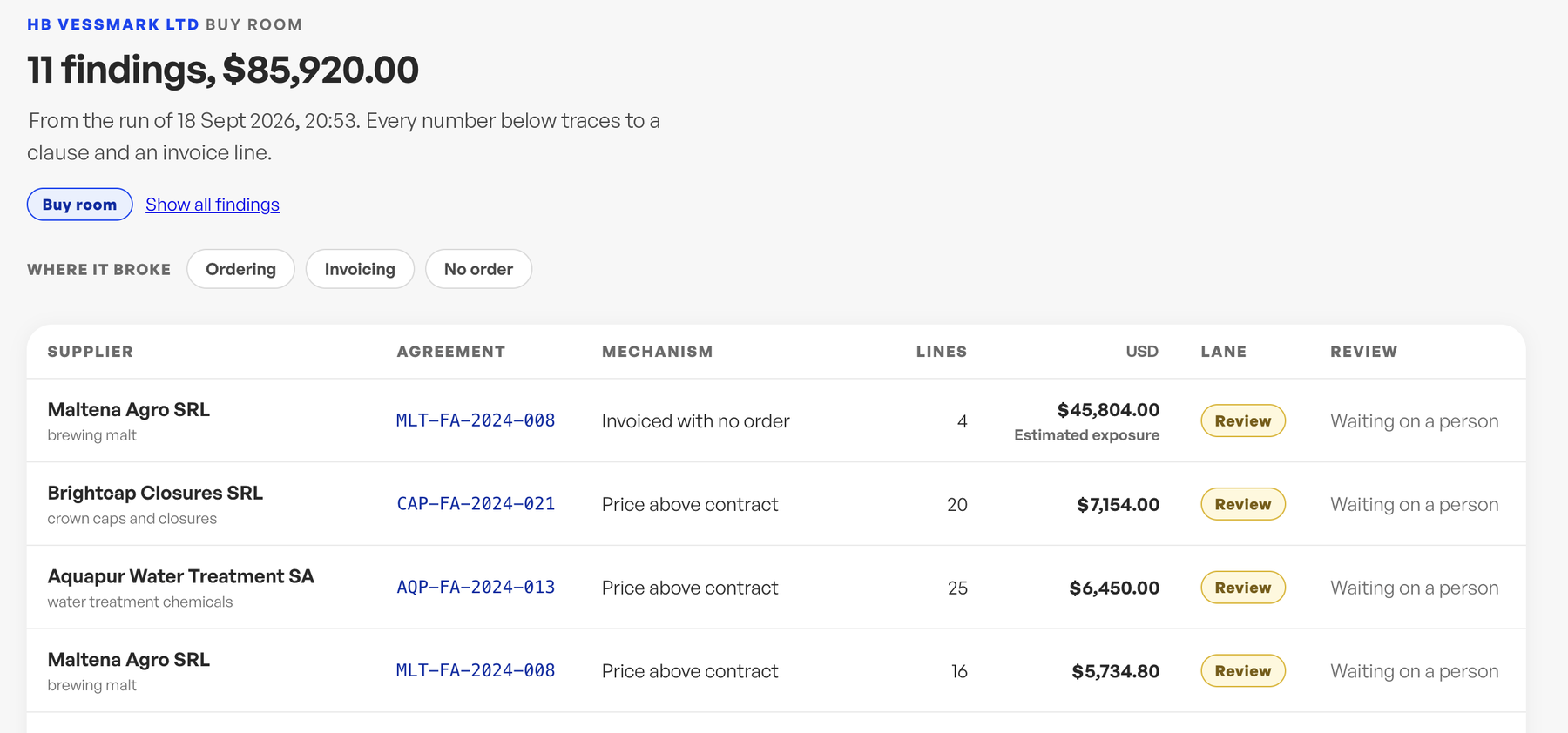
Every batch produced since yesterday, against its specification and the lots it consumed. Every complaint that arrived, connected to its batch. A batch with an out-of-spec input or an open complaint is visible the morning after, with the records behind it.
One process, one month, on data exports, no integration. You choose the process. We read the agreements and the exports, and a month later your team opens this page on your own records.
Send us the exports for one process. A month later your team sees every record of that process against the agreements that govern it, with the clause next to each one.
contact@evenrow.ai